Press review: India, EU sign mother of all deals and Moscow offers Iran‑US mediation
Top stories from the Russian press on Wednesday, January 28th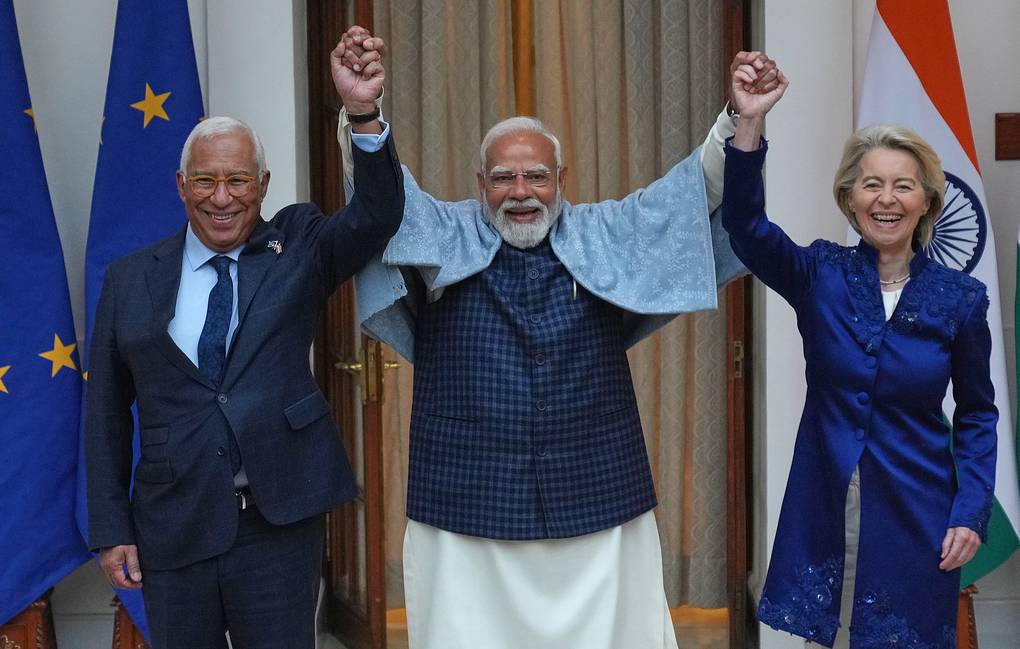 European Council President Antonio Costa, Indian Prime Minister Narendra Modi and European Commission President Ursula von der Leyen
MOSCOW, January 28. /TASS/. India signed the "mother of all deals" with the EU, and Moscow is willing to act as a mediator between Iran and the United States. Meanwhile, Syria’s interim leader Ahmed al-Sharaa is expected to visit Moscow later on Wednesday. These stories topped Wednesday’s newspaper headlines across Russia.
Media: India, EU sign `mother of all deals’
On January 27, the European Union and India concluded talks on establishing a free trade zone, according to a statement from the 16th India-EU summit. European Commission President Ursula von der Leyen and Indian Prime Minister Narendra Modi called it the most important trade agreement of all time.
The Indian PM wrote on X that the "mother of all deals" was signed on January 26, when his country marked the 77th Republic Day. In 2024, trade between the EU and India amounted to 120 billion euros, according to Eurostat, with India being the bloc’s ninth-largest trade partner and the EU being India’s second-largest trade partner.
The deal is a win for India, Gleb Makarevich, junior researcher at the Center for Indo-Pacific Studies under the Russian Academy of Sciences’ Institute of World Economy and International Relations, told Vedomosti. For India, it entails the development of an export-oriented economy, the construction of new businesses, the creation of new jobs as well as the resolution of socio-economic problems, Makarevich said. India is pursuing the key goal of 8% annual GDP growth, and New Delhi realizes that exports to a vast and solvent market would contribute to reaching that. India had been in talks with Brussels since 2007, but those accelerated last year under tariff pressure from US President Donald Trump, Makarevich acknowledged.
There is no provision making it obligatory for New Delhi to join the anti-Russian sanctions in the India-EU trade deal, the Indian embassy in Moscow told Izvestia, even as Brussels tried to add such a clause to the document, according to the European Parliament. Russia will be able to assess the potential consequences of the deal only after all protocols have been made public, the Russian Economic Development Ministry specified. What is clear already is that the establishment of a free trade zone between India and the EU will not close the doors to signing a similar agreement between the republic and the EAEU, a scenario currently being discussed, the ministry said.
It’s worth noting that relations between Russia and India have progressed to the level of "a special and privileged strategic partnership," Tatyana Shaumyan, head of the Center for Indian Studies at the Russian Academy of Sciences’ Institute of Oriental Studies, told Izvestia. "This is evident from practical steps, with the number of [Indian] consular offices rising in Russia <…>. This, I think, indicates continued interest in relations with India and the need to expand cooperation," the expert explained.
Izvestia: Moscow ready to act as mediator between Iran, US
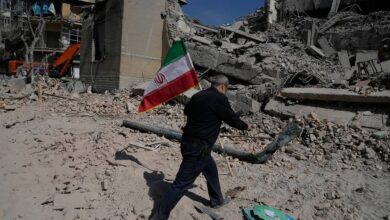
The Middle East is on the brink of war as experts say the United States may launch an attack on Iran, one of the largest countries in the region. A US carrier strike group is now in the Indian Ocean. Washington explains the move by an ambition to pressure Tehran into signing a new nuclear deal, even as the United States and its allies have repeatedly sabotaged similar agreements with the Islamic Republic in the past.
"We are always ready to offer our mediation, if both negotiating parties ask us, which they have not done yet. Of course, Washington and Tehran must negotiate, but the impression is forming that the lack of progress on the bilateral track is largely due to the specifics of the extremely demanding negotiating approaches on the part of the United States, which look more like an ultimatum," Mikhail Ulyanov, Russia’s permanent representative to international organizations in Vienna, told Izvestia.
There is indeed a high likelihood of a US attack on Iran, Vadim Koroshchupov, a junior research fellow at the Institute of World Economy and International Relations, told Izvestia. The New York Times reported that the United States has dispatched a dozen F-15E fighter jets to the region, and the USS Abraham Lincoln is carrying the latest F-35s, too.
Since the June war, Iran has strengthened its air and missile defense systems, Middle East expert Leonid Tsukanov told Izvestia. According to Israel, the country has roughly 1,500 ballistic missiles in service as it also enjoys the support of Yemen’s Houthis and Lebanon’s Hezbollah, even as the might of the Axis of Resistance has been significantly weakened as a result of the Gaza war.
If major damage is inflicted on Iran, the republic could respond by striking US military bases in Arab countries or a key US ally, Israel. Moreover, Iran could block the Strait of Hormuz, through which the bulk of Middle Eastern oil passes. "If Iran does so, oil prices will soar, which would harm the United States too," Konstantin Blokhin, research fellow at the Center for the Study of Security Problems at the Russian Academy of Sciences, warned.
Vedomosti: Syria’s interim president to visit Moscow
On Wednesday, Syria’s interim President Ahmed al-Sharaa will make an official visit to Moscow for talks with Russian President Vladimir Putin, Syria TV and Sham TV reported. This will be al-Sharaa’s second visit to the Russian capital since Hay'at Tahrir al-Sham (HTS, outlawed in Russia as a terrorist organization) captured power in December 2024. The two leaders will hold talks amid the ongoing tensions between Damascus and the Kurdish armed formations in the northeastern Arab Republic and the withdrawal of Russian troops from the Qamishli airport in Al-Hasakah Governorate. Neither Russia nor Syria has officially commented on the upcoming visit yet.
In Moscow, al-Sharaa will primarily seek political support from the Russian leadership amid recent developments in northeastern Syria, Russian International Affairs Council program manager Ivan Bocharov surmised. "Russia has traditionally been extremely responsible in addressing problems faced by confessional minorities in the Middle East; therefore, Damascus will likely try to draw on Russian experience and opportunities to stabilize the situation in its country," the expert explained to Vedomosti. In addition, he continued, the Russian military could, in theory, patrol southern Syria, which would allow Damascus to stabilize the situation in areas primarily inhabited by the Druze and ease tensions with Israel, he added.
Finally, the Syrian leadership expects to bolster trade and economic ties with Russia as it also counts on Moscow’s assistance in reviving the Syrian economy devastated by the war, Bocharov added.
Al-Sharaa’s second visit to Russia shows that Russian-Syrian relations are returning to the level of strategic partnership, Middle East expert Kirill Semyonov argued. The process was launched at the previous round of talks in October, and the two sides have held several joint meetings of intergovernmental commissions ever since, the expert recalled. "The latest talks cover a wide range of topics as they span beyond the issue of continued Russian military presence in Syria. The upcoming Syrian-Russian talks will give an additional impetus to deepening cooperation in the sphere of security, defense, culture as well as economy," he said.
According to Semyonov, the scheduled Russia-Syria summit in Moscow has nothing to do with the withdrawal of Russian troops from the Qamishli airbase.
Izvestia: Pakistan looking for alternative to Middle Eastern LNG in Russia
Moscow and Islamabad are working on gas exploration projects in Pakistan, Ambassador of the Islamic Republic to Russia Faisal Niaz Tirmizi told Izvestia. In addition, he said, Pakistan is interested in purchasing Russian LNG. Russian companies could indeed become a good alternative to imports from Qatar, analysts say. The development of trade relations between the two countries has been hampered by Western sanctions, which could necessitate the creation of an independent payment system.
Pakistan’s interest in Russian natural gas is dictated not only by political considerations but also by an acute demographic need: as of January 26, the country’s population exceeded 250 million, rising at an annual pace of 1.6%. This puts colossal pressure on the domestic energy market and also makes Russian investment in Pakistan strategically justified.
According to Igor Yushkov, an expert at the Russian Financial University, Russia could benefit from the participation of its companies in projects to build gas infrastructure in Pakistan as contractors, enabling the country to increase blue fuel consumption. "We can offer them LNG from sanctions-affected projects," he said.
Trade between Russia and Pakistan has been mostly marred by payment difficulties amid Western sanctions. Moreover, Pakistan is currently facing a tough financial situation, and if Islamabad finds resources to pay for Russian supplies, those could be carried out, Vladimir Sotnikov, an expert in South Asia, explained to Izvestia.
Vedomosti: Why Trump took aim at South Korea again
South Korea stated that the trade agreements reached between President Lee Jae-myung and US leader Donald Trump in late October have de facto been in place even without formal approval from the parliament. Seoul was surprised by a Truth Social post from January 27 in which Trump announced an increase in renewed reciprocal tariffs from 15% to 25% citing what he called the failure by South Korean legislators to enact the "historic trade agreement."
The South Korean government held an emergency meeting on Tuesday to discuss Trump’s post as it called for keeping calm until any legal confirmation comes from the United States. Indeed, there was no specific date for the latest decision to come into force mentioned in Trump’s post, which leaves room for maneuvers.
However, the media questioned whether delayed parliamentary procedure caused Trump’s ire this time around. Both Chosun Ilbo and Reuters reported, citing sources, that another conflict situation might have been the pretext, namely recent claims filed by South Korea against Coupang, a major e-commerce platform.
Senior Research Fellow at the Institute for US and Canadian Studies Dmitry Kochegurov doubts Seoul is really postponing the ratification of the deal, arguing that Trump believes the opposite and would like to hurry them up. The US president is driven by the desire to demonstrate tangible results, preferably economic ones, to his electorate, not least because he is losing the popularity he once enjoyed in this area, the expert explained.
Legislative procedures on the investment plan will be expedited in the wake of Trump’s threats as "there is nothing else for Seoul to do but negotiate with Washington," Alexandra Zuyeva, an expert at the Center for Military-Economic Studies at the Institute of Global Military Economics and Strategy, told Vedomosti. Commenting on the situation around Coupang, the expert said the probe against it was one of the reasons behind the latest US pressure on South Korea. According to Zuyeva, this is not a major story for Trump, and "he is seeking to exert pressure because he wants the deal implemented as soon as possible," the expert concluded.