Press review: Russia ready to resume Ukraine talks in Middle East as UAE plans OPEC exit
Top stories from the Russian press on Wednesday, April 29th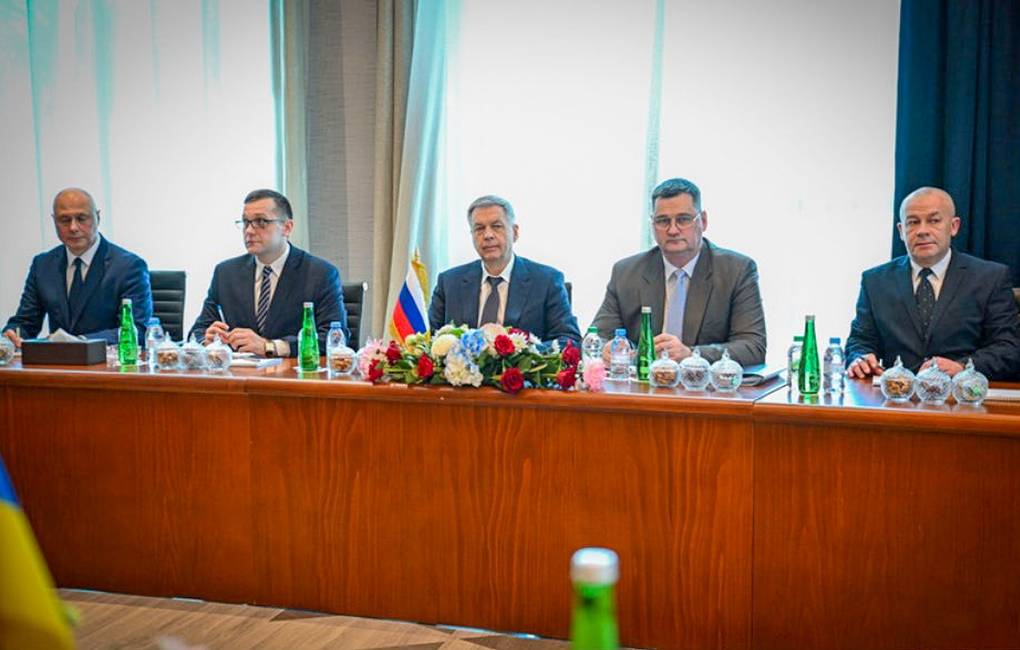
MOSCOW, April 29. /TASS/. Russia is ready to resume Ukraine talks in the Middle East; the US is waiting for Tehran to deplete its weapons as talks stall; and the UAE announces plans to withdraw from OPEC and OPEC+. These stories topped Wednesday’s newspaper headlines across Russia.
Izvestia: Russia ready to resume Ukraine talks in Middle East
Moscow is ready to ask Middle Eastern countries to once again host talks on Ukraine, Russian Deputy Foreign Minister Georgy Borisenko told Izvestia. He stressed, however, that choosing a location is a technical issue, while the main question is whether the key players have the will to build dialogue.
The Iran war, which broke out on February 28, complicated trilateral communication between Russia, the United States and Ukraine, which had taken place in the Middle East. Moreover, the conflict with Tehran almost completely captured the White House’s attention. Therefore, Ukraine talks are unlikely to restart in the near future, experts say. Kiev’s position is the main problem as Ukraine sees no need to engage in dialogue with Moscow and seek compromises.
"We see and know what the parties’ positions are. The US officials that particularly initiated the process, have distanced themselves from it due to the Iran situation," Denis Denisov, an expert at the Financial University under the Russian Government, pointed out. "That said, since Russia and Ukraine aren’t putting forward any initiatives regarding bilateral communication or any other negotiation formats, the involved parties actually appear to lack the necessary will. As a result, we can see that the process is stagnant," he added.
Besides, analysts emphasize that Vladimir Zelensky is currently unwilling to make compromises not only in dialogue with Russia but with the US as well. Earlier, he publicly expressed doubt that US President Donald Trump was capable of acting as a guarantor of peace in Ukraine. "Zelensky believes that Trump is going to lose the upcoming congressional elections, which is why he is behaving this way. The EU has allocated enough money for him to continue the war for another two and a half years," Oleg Tsaryov, former member of Ukraine’s Verkhovna Rada (parliament), stressed. Talks on Ukraine may resume as the fall draws near, when another window of opportunity is likely to open, Tsaryov believes.
Meanwhile, a thing to note is that the Europeans are trying to join the process, former Verkhovna Rada member Vladimir Oleinik noted. Earlier, German Chancellor Friedrich Merz stated that Kiev would probably have to accept giving up part of Ukraine’s territory for the sake of future EU membership.
Media: US still waiting for Tehran to run out of weapons
Washington’s statements about Tehran running out of missiles could be premature. Despite US-Israeli strikes on Iran’s infrastructure facilities, a large part of the country’s production capacities is hidden underground and remains operational. Tehran is still capable of choosing between a dramatic escalation and a protracted conflict strategy. It is this choice that will determine how the conflict in the Middle East unfolds, Izvestia notes.
US administration considers option of declaring end to Iran war — Reuters
Experts see two potential scenarios. The first one implies a sharp increase in missile launches aimed at suppressing enemy air defenses, military expert Dmitry Kornev said. But in such a case, the country will run out of its arsenals very quickly.
"The second scenario means a long war. The available data shows that this is the strategy Tehran has sought to pursue in April. It’s about taking drastic measures to save missiles and make the war last longer, one to six months," the expert explained. Such tactics will require Iran to try to survive under massive airstrikes, so it’s possible Tehran will eventually choose the first option.
Iran’s missile industry has most likely been damaged but not paralyzed, military expert Yury Lyamin believes. The current situation means a temporary slowdown in production, which Tehran can offset in quite a short time, based on its experience.
Meanwhile, reports of communication between Washington and Tehran are reinforcing the impression that the talks have stalled, Nezavisimaya Gazeta notes. US President Donald Trump has said Iran asked the US to unblock the Strait of Hormuz as soon as possible and that the Iranian government is in chaos. However, the Iranians have rejected these allegations, blaming the US for suspending negotiations. That said, it’s a strange situation with no peace and no war. Trump announced an indefinite extension of the ceasefire with Iran, but the US continues to deploy forces to the Middle East. Iran also does not believe the war is over. The country does not recognize Trump’s ceasefire, and although Tehran is not currently conducting military operations, it is preparing for a situation where hostilities may resume at any moment.
Media: UAE announces plans to withdraw from OPEC, OPEC+
The United Arab Emirates has announced that on May 1, it will withdraw from OPEC and OPEC+, which coordinate decisions on oil production by the largest market players. The move stems from a disparity between OPEC’s policy and the UAE’s long-term energy strategy, as well as from the country’s disagreements with other member states and regional neighbors, said experts interviewed by Vedomosti.
FACTBOX: What is known about UAE’s decision to quit OPEC, OPEC+
Sergey Suverov, investment strategist at the Aricapital asset management company, does not rule out that the decision had been made before the situation in the region escalated and that it reflects the country’s long-term policy. The UAE seeks to maximize output as it has invested heavily in production infrastructure in the past ten years, but OPEC+’s policy keeps it from implementing this strategy, Suverov said. The UAE would like to be able to react more flexibly to market price changes and pursue an independent energy policy, the expert added.
Suverov expects that the UAE’s move will cause significant damage to OPEC+ but the relevant agreement will remain in effect. Despite a high level of oil production in the UAE, the group's only backbone members are Saudi Arabia and Russia, he noted. Dmitry Kasatkin, managing partner at Kasatkin Consulting, believes that the future of OPEC and OPEC+ depends on what choice Saudi Arabia makes and whether it tries to prevent other countries from leaving the organization.
Igor Yushkov, an expert at the Financial University under the Russian Government, told Kommersant that other nations were unlikely to announce decisions to withdraw from OPEC immediately, even if they chose to. The conflict in the Middle East has restricted output and exports in many member states, so it’s important for them to preserve high oil prices, he observed. The analyst expects that once the Strait of Hormuz is reopened, the question will arise about rising quotas for other producers.
Analysts at Freedom Finance Global believe that it’s not the UAE’s withdrawal from OPEC+ that poses a risk to Russia but the group’s potential collapse and a prolonged period of low oil prices that may begin after the Iran conflict is over.
Izvestia: Situation in Mali remains tense
Tensions are rising in Mali due to attempts by jihadists and separatists to seize power in the West African nation. The central government says rebels seek to undermine stability in the country as it was done in Syria. However, a Syria-like scenario is unlikely to be implemented in Mali, said experts interviewed by Izvestia.
Coup attempt thwarted in Mali: Russian Defense Ministry’s statements
Grigory Lukyanov, researcher with the Center of Arab and Islamic Studies at the Russian Academy of Sciences’ Institute of Oriental Studies, points out that desert areas in northern Mali provide enormous opportunities for maneuvering, which is what the Bamako government’s opponents have exploited.
The crisis in Mali is playing into the hands of European Union countries, whose positions in the region weakened following an outburst of anti-Western sentiment in Africa. That said, even though the Europeans aren’t financing the rebels directly, they are creating the necessary background for undermining Mali’s government camp in the eyes of the global majority. France is unsurprisingly trying harder than others. The Elysee Palace craves to turn the tables on the continent and is looking for any options to prove alternative security systems ineffective.
A rapid offensive by Bamako’s opponents revived discussions of the Malian government's stability. Parallels are being drawn particularly with the 2024 Syria crisis, where armed opposition managed not only to destabilize the situation on the front in a short time but also to fully paralyze the Bashar Assad regime. However, what makes the two crises different is that Mali’s army remains combat-ready and disciplined. Not the least role in this is being played by the Africa Corps, which ensures a stable zone of control for government forces.
Lukyanov notes that the Syria-like scenario included not only the fall of the old regime but also the collapse of an outdated political system. Developments in Mali don’t fit into this theory. "Unlike Syria, the current government in Mali does not have a long history of the country’s system decaying and becoming illegitimate in the people’s eyes. Mali’s political elite has not been discredited, which is what happened in Syria in 2024," the analyst elaborated.
Media: Poland releases Russian researcher in deal with Belarus
Russian archaeologist and Hermitage Museum employee Alexander Butyagin, who was detained in Poland and faced extradition to Ukraine, has been released as part of a swap deal with Belarus. The museum has said the researcher will resume his academic journey now that he is free, Vedomosti writes.
A source close to Butyagin’s defense team told the newspaper that the archaeologist had been released through Belarus because "Warsaw could not accept sending him directly to Russia."
Archaeologist Butyagin’s release: what we know about swap on Belarusian-Polish border
The Polish authorities freed Butyagin amid a strong public outcry, because his detention had been outrageous, said Dmitry Bunevich, advisor to the director of the Russian Institute for Strategic Studies. The archaeologist’s extradition to Ukraine would have put his health at risk, sparking resentment in academic circles, the expert believes. According to him, Poland’s Foreign Ministry must have realized that his extradition would deal a blow to Warsaw’s prestige and put Polish researchers in an awkward situation.
Ivan Melnikov, vice president of the Russian branch of the International Committee for Human Rights, told Kommersant that Poland’s move to release the Russian researcher was "a canny move." In his view, Warsaw would have under no circumstances dared to hand him over to Ukraine. Melnikov sees the case as a striking example of political persecution and points out that the Polish authorities had no right to extradite the researcher to Kiev. One of the reasons why is because Warsaw ratified the conventions and agreements that make it impossible to extradite a person to a country where their life and health will be in danger and where hostilities are underway.
Poland was interested in such an exchange as it seeks to highlight the important role it plays in the European Union and on NATO’s eastern flank. Belarus and its President Alexander Lukashenko, in turn, have appropriately acted in close coordination with Moscow and in line with the Belarusian leader’s political style, Bunevich told Vedomosti. "The Butyagin story is further proof of strong relations between Moscow and Minsk," the expert emphasized.